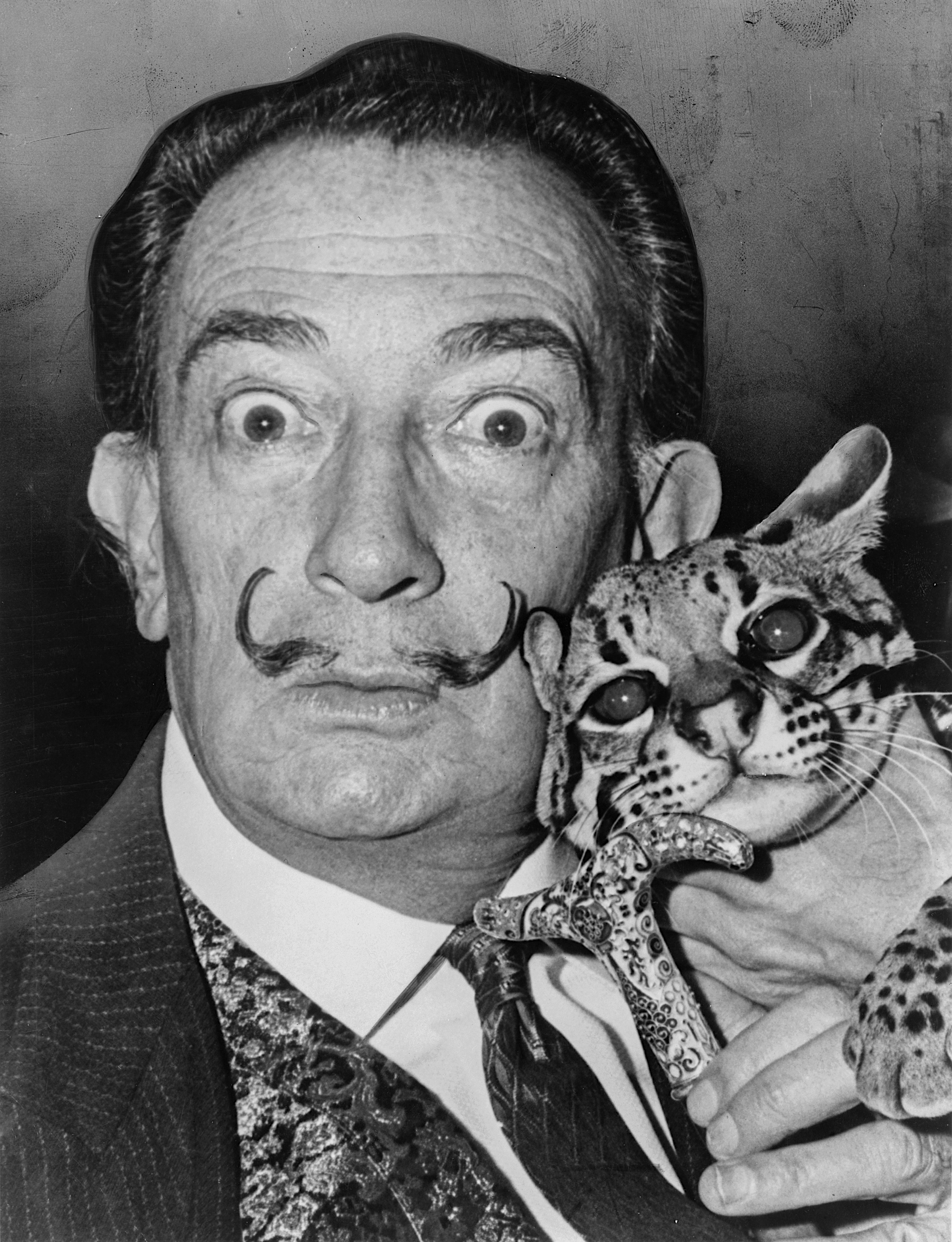
Salvador Dalí
Methodology
Dalí's intellectual method centers on what he termed the "paranoid-critical activity"—a systematic approach to creative production that harnesses delusional thinking while maintaining rational control. Unlike automatic writing or pure unconscious expression favored by orthodox Surrealists, Dalí insisted on conscious simulation of paranoia: the deliberate cultivation of multiple interpretations of a single image or phenomenon. He argued that paranoia, as a systematic delirium of interpretation, could be voluntarily induced and controlled to generate novel associations and visual discoveries. This method transforms subjective irrationality into communicable artistic content through technical mastery. His epistemology celebrates ambiguity and double images—visual configurations that simultaneously represent multiple objects—as portals to deeper psychological truth. He believed the subconscious contained more verifiable reality than conscious perception, and that dream imagery, when rendered with photographic precision, could convey authentic experience. Dalí rejected abstraction in favor of hyper-realistic technique applied to impossible content, insisting that only meticulous academic skill could make delirium legible. His thinking fuses Freudian psychoanalysis, Catholic mysticism, scientific curiosity (especially quantum physics and DNA), and theatrical provocation into a coherent if flamboyant system for accessing and communicating unconscious material.
Sample argument
On the question of artistic originality: The paranoid-critical method allows the artist to systematically organize confusion and contribute to the total discrediting of the world of reality. Through this voluntary simulation of paranoid states, I can impose my own systematic interpretation onto any object or phenomenon. The melting watch, for example, contains multiple simultaneous truths—the softness of time, the decay of certainty, the Camembert cheese of memory. Where others see contradiction, I see enrichment. The academic painters dismissed by modernists possessed something essential: the capacity to make delirium concrete. Without the rigorous techniques of Meissonier or the Dutch masters, my dreams would remain private and incommunicable. Precision is not the enemy of the irrational—it is its necessary vehicle. My task is to photograph, with the maximum clarity, the images of concrete irrationality. The hand-painted dream photograph must surpass photography itself in exactitude to capture what mechanical recording cannot: the systematic delirium that constitutes our truest reality.
Cognitive style
Themes
Traits
Topics
- Epistemology — Knowledge emerges through paranoid-critical method—systematic organization of confusion. Double images and ambiguity reveal deeper truths than rational clarity.
- Religion — Maintained complex relationship with Catholicism; later works fused religious symbolism with scientific imagery in attempt to reconcile mysticism and rationality.
- The Self — The subconscious self represents truest reality; explored identity through systematic access to dreams, paranoid states, and symbolic imagery rendered with precision.
- Science — Later work integrated nuclear physics, DNA structure, and mathematical forms into mystical-scientific synthesis, especially in Nuclear Mysticism phase.
- Technology — Embraced technological innovation in art production; explored photography, film, holography as extensions of artistic vision and precision.
Image: Roger Higgins, World Telegram staff photographer (Public domain) · Source