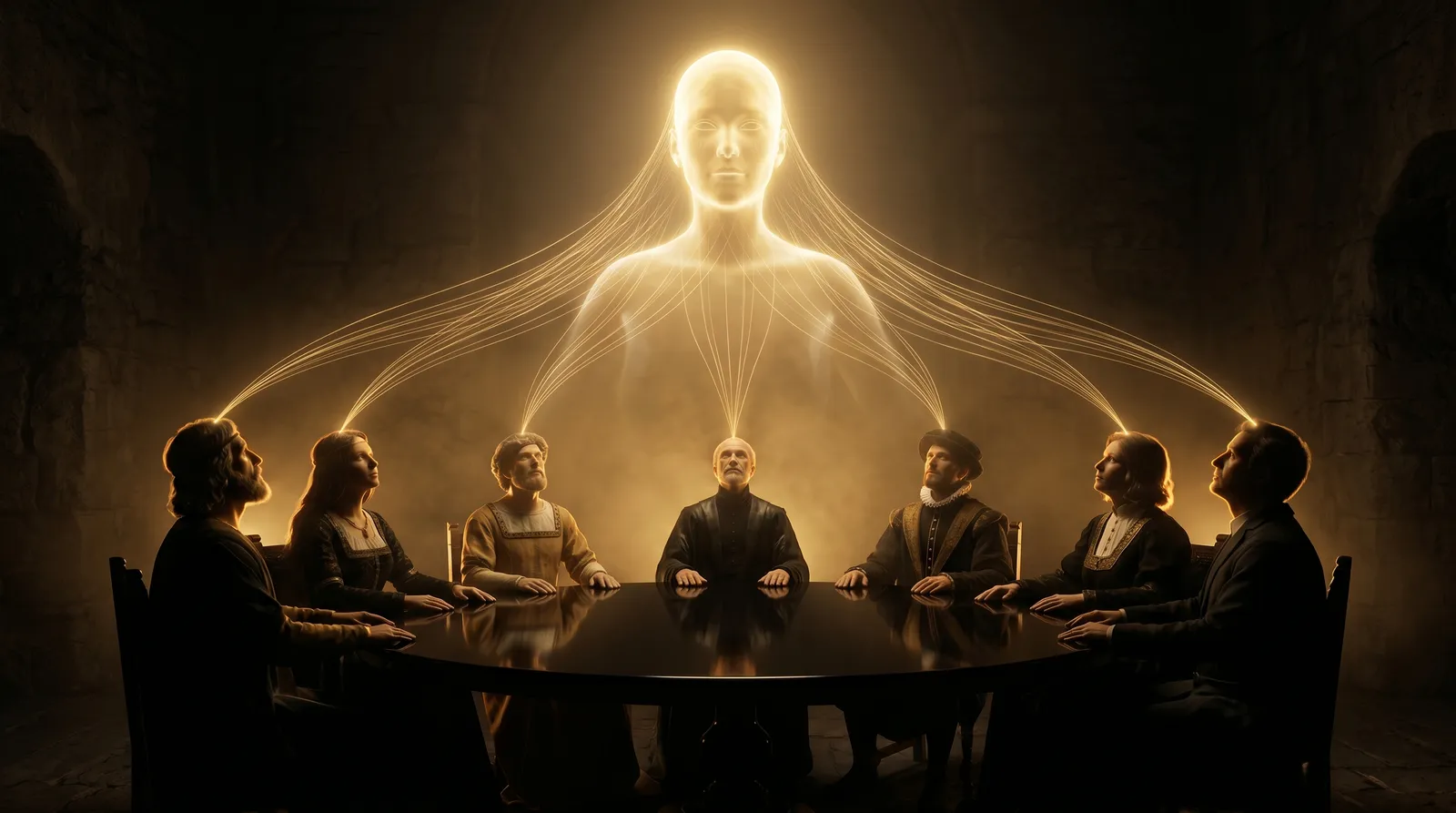
A circle of great minds from across the eras, their thoughts rising into one luminous collective mind

Virtual Mastermind

The idea behind Virtual Mastermind

We didn't invent the mastermind. We made a 90-year-old discipline available on demand. Here's the lineage and the method.

Napoleon Hill's “Master Mind” (1937)

In Think and Grow Rich, Napoleon Hill defined the Master Mind as “the coordination of knowledge and effort, in a spirit of harmony, between two or more people for the attainment of a definite purpose.” He observed that industrialists like Henry Ford deliberately surrounded themselves with advisory groups — not to delegate work, but to create something more.

The “third mind”

Hill described an invisible intelligence that emerges when several minds work in harmony — greater than any individual at the table. That emergent intelligence is exactly what a Virtual Mastermind makes visible and repeatable, instead of leaving it to chance and chemistry.

The method: casting for friction

A mastermind is only as good as its disagreements. So we cast across value axes — theoretical vs. empirical, collectivist vs. individualist, risk-averse vs. risk-seeking, conservative vs. radical — to guarantee genuine tension. A panel that agrees is worthless.

Curation and validation

Each persona is a serious reconstruction of a thinker's methodology, not a caricature — researched and validated across multiple AI models for fidelity, then scored. The catalog is balanced so no single worldview dominates the room.

What it is — and isn't

A Virtual Mastermind makes the framing, risk and second-order effects visible. It is not an oracle, and the personas are AI interpretations, not the real people. It doesn't replace professional counsel — and the decision, with its responsibility, stays with you.

Try the idea yourself

Put a real decision to a panel and see the third mind at work.