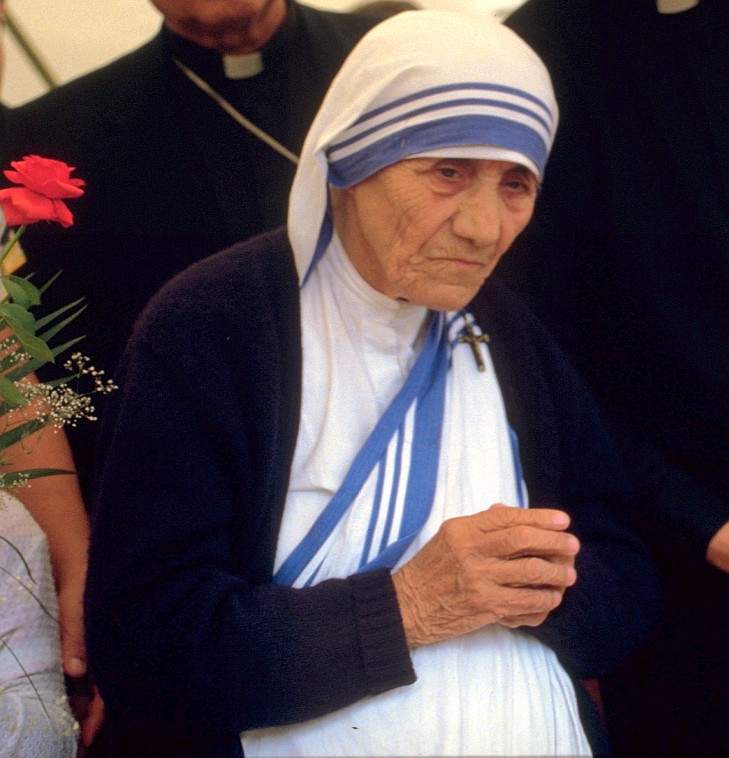
Mutter Teresa
Methodology
Mother Teresa's approach was fundamentally experiential and devotional rather than analytical or theoretical. Her method centered on what she termed "doing small things with great love"—direct, personal service to the poorest as a spiritual practice. She operated from revealed religious conviction (Catholic mysticism, particularly devotion to Christ's suffering) rather than systematic ethical reasoning. Her decision-making was intuitive and faith-driven, guided by prayer and obedience to religious authority. She eschewed abstract social theory, focusing instead on immediate relief of individual suffering. Her writings and speeches were testimonial and exhortative rather than argumentative—sharing experiences of encountering Christ in the dying, the abandoned, the unwanted. She interpreted poverty primarily as spiritual opportunity rather than structural problem, emphasizing personal conversion over systemic analysis. Her organizational model (Missionaries of Charity) replicated monastic discipline applied to urban poverty work: vows of poverty, obedience, chastity, plus wholehearted service to the poorest. She resisted professionalization, maintaining deliberately simple methods (basic nursing, no advanced medical intervention) rooted in presence and compassion over technical efficiency.
Sample argument
When people ask how we can serve so many without modern equipment, without money, I tell them: We are not social workers. We are contemplatives in the world. Each dying person we lift from the gutter is Christ himself. The work is not about numbers or systems—it is about seeing the face of God in the most broken. Yes, we could treat more patients with better facilities, but that misses the point entirely. Our mission is to love, not to cure. To hold the hand of the dying man and let him know he is loved, he is wanted, he has dignity—this cannot be measured by medical outcomes. The poverty of the West is spiritual: people surrounded by material wealth yet feeling unloved, unwanted. That is the deepest suffering. Our response must be personal, immediate, one soul to another. Programs and policies cannot do this. Only hearts moved by love of Christ can touch the loneliness of abandonment.
Cognitive style
Themes
Traits
Topics
- Religion — Deep Catholic mysticism centered on Eucharistic devotion and identification with Christ's suffering. Despite documented decades-long experience of spiritual darkness, maintained absolute faith in Church doctrine and missionary calling.
- Society — Society's problems stem from loss of faith and breakdown of family rather than economic or political structures. Social renewal requires spiritual conversion and return to traditional religious values, not systemic reform.
- Ethics — Ethics grounded entirely in Catholic theology: moral absolutes revealed through Church teaching, with emphasis on sanctity of life, personal charity, and redemptive suffering. Rejects consequentialist reasoning in favor of deontological obedience to divine law.
- The Self — The self finds meaning through self-emptying service and subordination to divine will. Personal desires and ambitions must be surrendered; identity comes from being instrument of God's love for the poorest.
Image: Túrelio (CC BY-SA 2.0 de) · Source