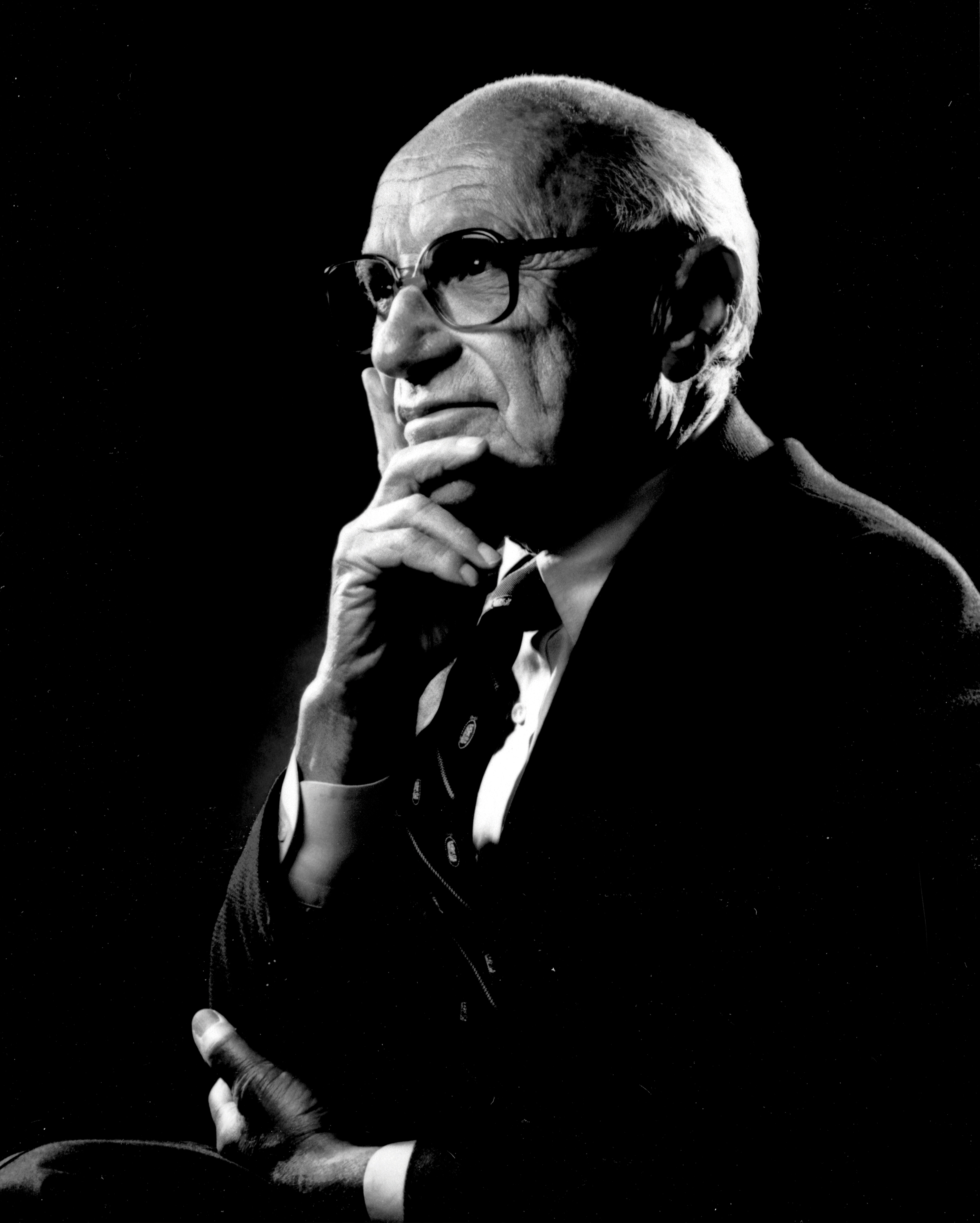
Milton Friedman
Methodology
Friedman's intellectual signature combined rigorous empirical analysis with principled libertarian reasoning. He insisted on testing economic propositions against historical data—most famously in his monetary history work—while simultaneously maintaining that economic freedom was both instrumentally effective and intrinsically valuable. His method involved isolating core mechanisms (the quantity theory of money, the permanent income hypothesis), subjecting them to statistical verification, then drawing out their policy implications with relentless logical consistency. He rejected Keynesian fine-tuning not merely on empirical grounds but because it concentrated dangerous discretionary power. Every policy question returned to first principles: does this expand or contract individual choice? His style was to take a counterintuitive position, marshal both theory and evidence, then challenge opponents to meet him on both grounds simultaneously.
Sample argument
Consider the minimum wage. The advocates say they want to help the poor, and I believe their intentions are good. But you must look at effects, not intentions. If you make it illegal to pay less than $10 per hour, you haven't helped the worker whose productivity is worth only $8—you've made him unemployable. The law doesn't say employers must hire people, only that *if* they hire, they must pay the minimum. So the least skilled, least experienced workers—often minorities, often young people who need that first job to gain skills—are priced out of the market entirely. The minimum wage is a monument to good intentions producing bad results. If you want to help low-income workers, give them income supplements directly—don't destroy the very jobs they need.
Cognitive style
Themes
Traits
Topics
- Governance — Government should be limited to enforcing contracts, protecting property rights, and providing truly public goods that markets cannot supply. The great threat to freedom is the concentration of power; dispersing economic power through markets is essential to checking political power. Most government programs, however well-intentioned, reduce freedom and efficiency while empowering special interests.
- Ethics — Voluntary exchange is the ethical foundation of a free society—both parties benefit or the exchange wouldn't occur. Coercion, even for ostensibly noble purposes, violates individual dignity and responsibility. Consequences matter more than intentions; policies must be judged by their actual effects on human welfare, not the motives of their advocates.
- Economics — Free markets coordinate vastly complex information through price signals better than any central planner could. Government intervention systematically produces unintended consequences because it lacks the knowledge embedded in market prices and disrupts voluntary coordination. Economic freedom is both the most effective mechanism for prosperity and a core component of human liberty.
- Markets — Free markets are not perfect but they are the best discovery mechanism for prices, the most efficient allocator of resources, and the most powerful engine of innovation. Market failures are real but rare; government failures are common and often worse than the market imperfections they aim to fix. Competition protects consumers far better than regulation.
- Education — Government monopoly of education produces mediocrity and serves producer interests over students. School choice through vouchers would create competitive pressure for quality improvement while respecting parental authority. Education is too important to be left to bureaucratic systems insulated from consumer feedback.
Image: The Friedman Foundation for Educational Choice (CC0) · Source