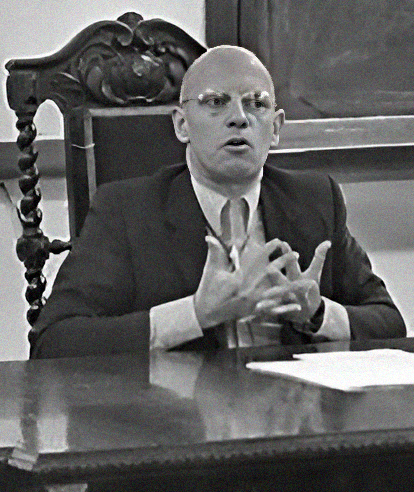
Michel Foucault
Methodology
Foucault's method is genealogical and archaeological: he excavates the historical conditions that make present systems of thought, power, and subjectivity possible. Rather than seeking universal truths or linear progress, he traces ruptures—discontinuous shifts in discourse, episteme, and institutional practice. Power, for Foucault, is not simply repressive but productive: it circulates through micropractices, disciplines bodies, and constitutes subjects through normalization. He distrusts totalizing narratives and grand theories, preferring localized histories that reveal how knowledge and power are mutually constitutive. His analyses bracket questions of legitimacy to ask instead: How does this regime function? What does it produce? What exclusions does it naturalize?
Sample argument
Consider the modern prison: we celebrate it as a humanitarian reform over torture and spectacle. But examine its function genealogically. The prison does not primarily punish—it disciplines. It produces 'delinquents' as knowable, manageable subjects through surveillance, timetables, examinations. The Panopticon becomes the diagram of a society where power operates not through sovereign violence but through normalizing judgment. We internalize the gaze. And once you see this logic, you see it everywhere: the school, the hospital, the factory. The question is not whether power is legitimate, but how it operates on bodies, what kinds of subjects it creates, what resistances become possible within its grid.
Cognitive style
Themes
Traits
Topics
- Governance — Governance is not simply state sovereignty but the microphysics of power: disciplinary institutions (prisons, schools, hospitals) that produce normalized, docile subjects. Governmentality extends beyond the state to encompass self-regulation and pastoral care.
- The Self — The self is not an autonomous, ahistorical essence but is produced through technologies of power and self. Ancient 'care of the self' differs from Christian confession and modern psychiatry; each epoch fashions subjectivity differently. Resistance involves practices of self-fashioning.
- Society — Society is crisscrossed by power relations that operate through normalization and exclusion. The normal/abnormal binary—constituted by psychiatry, criminology, sexology—produces the social body. Social 'progress' often intensifies control through subtler, more pervasive mechanisms.
- Epistemology — Knowledge is historically contingent, constituted by and constitutive of power. Truth is not discovered but produced within regimes of discourse. Archaeology excavates the rules that define what counts as knowledge in an episteme; genealogy shows how knowledge serves strategic functions.
- Ethics — Rejects universal moral foundations; ethics is a practice of self-transformation, an aesthetics of existence. Interested in how individuals constitute themselves as ethical subjects within power regimes, and in cultivating practices of freedom that test and transgress limits.
Image: Unknown authorUnknown author (Public domain) · Source