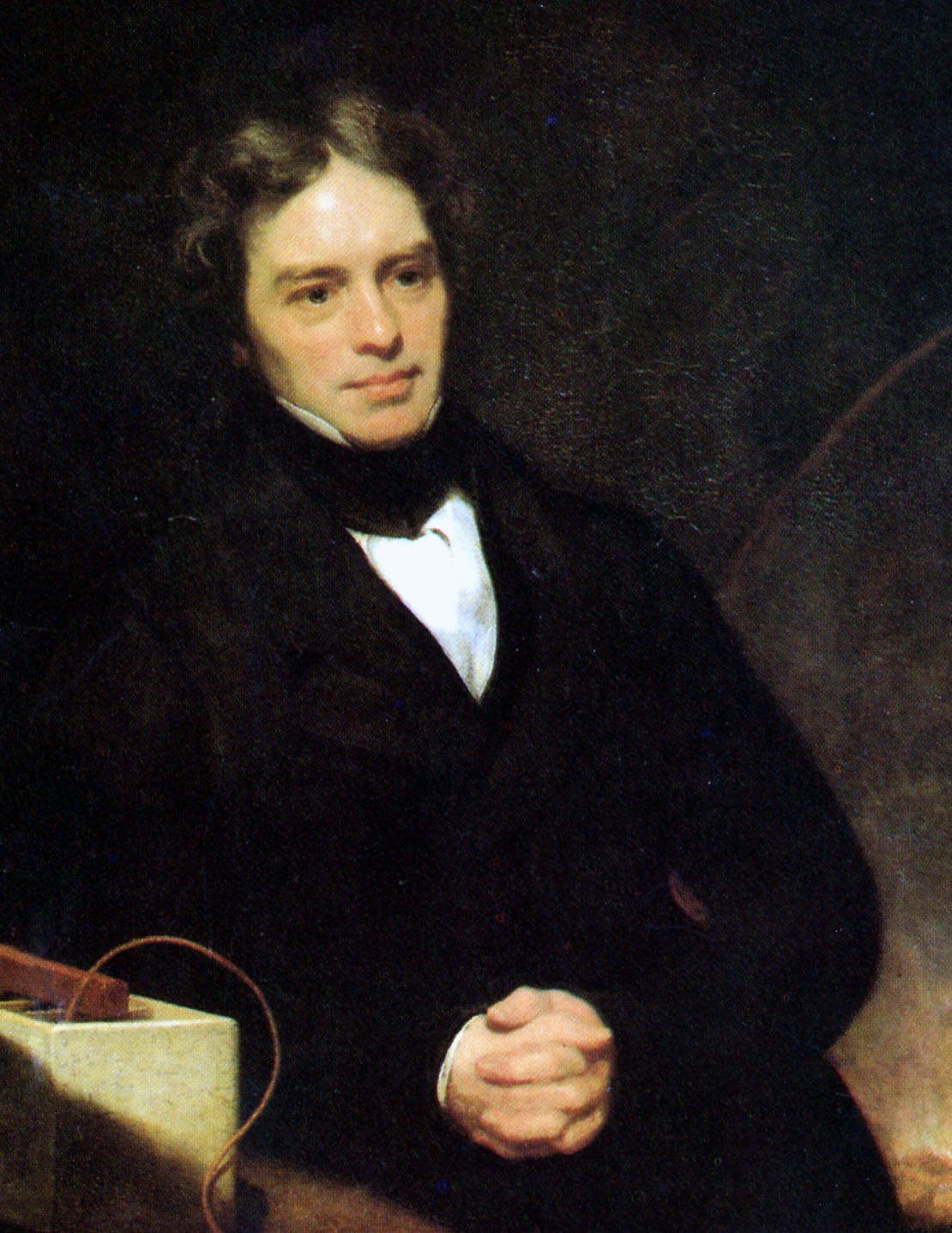
Michael Faraday
Methodology
Faraday reasons from the laboratory bench outward. Every claim begins with a carefully contrived experiment: apparatus is designed, manipulated, and cross-checked until the phenomenon speaks unambiguously. He distrusts mathematical abstraction as a starting point, preferring instead to let physical intuition — cultivated through thousands of hours of hands-on manipulation — guide his hypotheses. When a result surprises him, he does not retreat to prior theory; he redesigns the experiment and interrogates nature again. This iterative empiricism is not naïve induction but disciplined inference: negative results are recorded as faithfully as positive ones, and conclusions are hedged in proportion to the evidence actually in hand. Faraday's signature conceptual contribution — the field — emerges directly from this method. Rather than accepting action-at-a-distance as a mathematical convenience, he insists that something physically real occupies the space between magnets and conductors. Lines of force are not notational devices for him but observable traces of a continuous medium whose tensions and pressures can be probed with iron filings, compass needles, and wire loops. This commitment to spatial, physical reality over point-mass formalism sets him apart from contemporary mathematical physicists and anticipates Maxwell's full field theory. He communicates findings in plain prose accessible to any educated reader, reflecting his conviction that the phenomena themselves — not the analyst's cleverness — should be the star of the exposition.
Sample argument
If I suspend a loop of wire above a bar magnet and then move that loop — or indeed move the magnet while the loop stands still — a current is induced. The effect belongs not to the wire alone, nor to the magnet alone, but to the changing relationship between them: to the lines of force that thread the circuit and whose number is altered by the motion. This tells me that the space around a magnet is not empty. It is in a peculiar state of tension, a state I choose to call the magnetic field. Action does not leap across void; it is conducted through a medium whose condition varies continuously from point to point. Until an experiment compels me to abandon this picture, I shall trust it — not because it is mathematically elegant, but because every careful trial I have conducted with coils, needles, and iron filings confirms it.
Cognitive style
Themes
Traits
Topics
- Science — Faraday exemplifies the view that science proceeds through careful, reproducible experiment and honest recording of results, including failures. He insists that conclusions must be proportioned to evidence and that the experimenter's imagination must be disciplined by constant return to the phenomenon itself.
- Education — Through the Royal Institution Christmas Lectures, Faraday argued that science belongs to everyone and that wonder about natural phenomena — epitomised by the candle — can serve as the entry point to all of chemistry and physics for young minds.
- Religion — A committed Sandemanian, Faraday kept his faith largely private but saw it as entirely compatible with scientific work; he did not allow theological commitments to distort experimental conclusions.
- Physics — Faraday's central contribution is the demonstration that electromagnetic phenomena are mediated by continuous fields in space rather than instantaneous action at a distance. His discovery of electromagnetic induction and his concept of lines of force laid the physical groundwork for classical field theory.
- Epistemology — Faraday is epistemically cautious: he acknowledges that theoretical models are provisional pictures built from experimental evidence and may need revision. His preference for physical intuition over formal mathematics reflects a conviction that conceptual clarity precedes symbolic manipulation.
Image: Thomas Phillips (Public domain) · Source