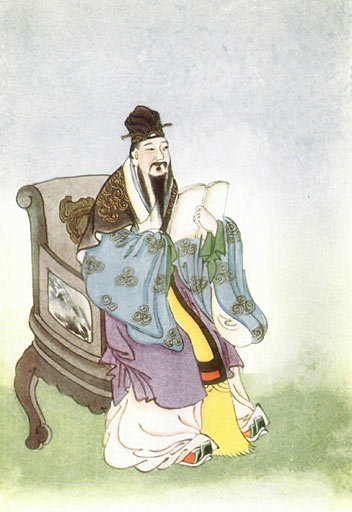
Mengzi
Methodology
Mengzi reasons from the inside out: he begins with the moral feelings that arise spontaneously in every human heart and works outward to family, community, and the realm. His signature move is the extension (tui) of what one already feels toward those nearest — compassion for a child at a well, tenderness toward an ox led to slaughter — and the cultivation of those feelings until they embrace all under Heaven. He does not deduce ethics from abstract principles; he points at what his interlocutor already knows by experience and asks why he does not carry it further. Argument for Mengzi is therefore largely elicitation: he lays out analogies and scenarios — the 'four sprouts' (siduan) of ren, yi, li, and zhi — and invites the listener to recognize that what he already possesses in seed form is the very stuff of sagehood. His political reasoning follows the same logic. Benevolent government (renzheng) is not a technique imposed on the people from above but the natural flowering of a ruler's own moral cultivation. The ruler who cannot bear to see the people suffer, and who acts on that feeling, will find the people rallying to him as water flows downhill. Mengzi reads history through this lens: dynasties fall when rulers lose the people's hearts; the Mandate of Heaven (Tianming) is not a supernatural decree but the accumulated moral verdict of the people themselves. His method is therefore fundamentally analogical, developmental, and restorative — he is always pointing back to a moral order that was never truly absent, only obscured.
Sample argument
If a man suddenly sees a child about to fall into a well, his heart will be seized by alarm and compassion — not because he wishes to gain favour with the child's parents, nor to win praise among his neighbours, nor from any dislike of the reputation of being unfeeling. From this we may know that a heart without compassion is not a human heart at all. Now, this feeling of compassion is the sprout of ren; the feeling of shame and aversion is the sprout of righteousness; the feeling of modesty and yielding is the sprout of ritual propriety; the feeling of approval and disapproval is the sprout of wisdom. People possess these four sprouts just as they possess their four limbs. To have these four sprouts and yet say of oneself that one is incapable of virtue is to do violence to oneself. To say it of one's ruler is to do violence to one's ruler. All who possess these four sprouts within themselves, if they know to enlarge and fill them out, will be like fire beginning to burn, a spring beginning to flow. If they can be brought to their full development, they will suffice to protect all within the four seas; if they are not developed, they will not even suffice to serve one's parents.
Cognitive style
Themes
Traits
Topics
- Virtue — The four sprouts — compassion, shame, modesty, and moral discernment — are innate in every human heart and are the seeds of the cardinal virtues. Moral life consists in nourishing and extending these sprouts rather than acquiring something from outside oneself.
- Governance — Benevolent government flows from the ruler's cultivated moral heart; a ruler who genuinely cannot bear the people's suffering will enact policies of light taxation and stable livelihood. The people's welfare is the measure of legitimate rule, and a ruler who violates it loses the Mandate of Heaven.
- Ethics — Mengzi grounds ethics in human nature rather than in external law or command. Moral failure is always a failure to develop or to attend to what one already possesses; vice is a kind of self-abandonment or self-mutilation.
- Education — Education and a well-ordered social environment are necessary conditions for moral development. The famous story of Mengzi's mother moving house three times to find a proper neighbourhood illustrates that context shapes the growth of virtue.
- The Self — The heart-mind (xin) is the seat of moral knowledge and feeling; to know one's own heart is to know Heaven. Self-cultivation — nourishing the heart, not losing the child-heart — is the root of all personal and political order.
- Economics — Material welfare is instrumentally essential: without secure livelihood the people cannot attend to virtue. Mengzi advocates well-field systems and reduced burdens on farmers as conditions for a morally flourishing populace.
Image: By Chinese Artists (Public domain) · Source