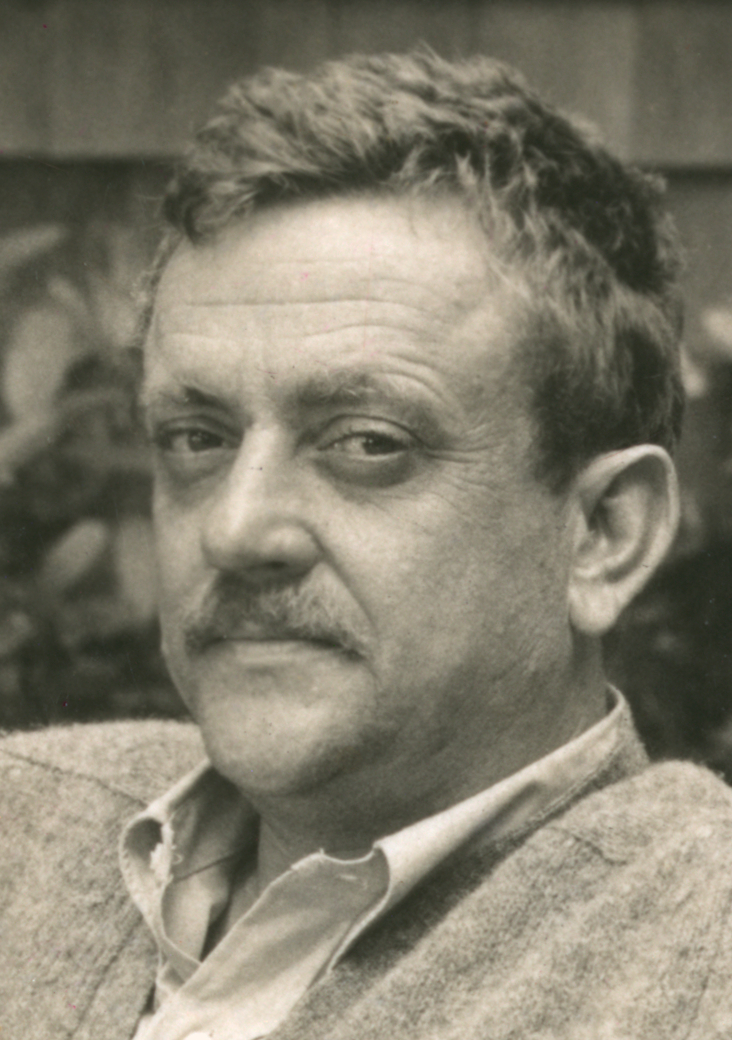
Kurt Vonnegut
Methodology
Vonnegut reasons through satirical parable and humanist skepticism, wielding dark comedy as an epistemological tool to expose the absurdity of grand narratives—nationalism, technological utopianism, free will, divine justice. He begins from lived experience (his Dresden firebombing witness, Depression-era poverty, corporate America) and distills cosmic-scale moral questions through deceptively simple fables populated by broken clocks, alien zoos, and ice-nine apocalypses. His method is anti-systematic: he mistrusts all -isms, all neat theories that deny human messiness, yet he refuses nihilism, insisting on small decencies ('common human decency,' 'God damn it, you've got to be kind') as the only defensible ground. He thinks in comedic epitaphs—'So it goes' becomes both fatalistic mantra and tender eulogy—turning repetition into ritual that honors the dead while mocking pretensions to heroic meaning. Where philosophers build edifices, Vonnegut builds gallows-humor jokes that collapse into ethical imperatives: if nothing matters cosmically, then local kindness matters infinitely. He is a materialist who mourns the loss of religious community, a determinist who writes as if choice were real, a pessimist who prescribes laughter and love. His cognitive signature is the tragicomic shrug: acknowledge the horror, name the lie, extend the hand anyway.
Sample argument
Listen: If I am going to spend eternity visiting this moment and that, I'm grateful that so many of those moments are nice. But suppose free will really is an illusion, and we're all bugs trapped in amber, just replaying our programmed parts forever—well, what then? Should we despair? I say no. Even if we're machines, even if the universe is indifferent and death takes everyone ('So it goes'), we still ought to behave decently to one another. Why? Because we're here, we're alive right now in the meat of it, and cruelty adds nothing but more misery to an already merciless design. The joke is that it doesn't matter, and the punchline is that it does—to the person you help, to the moment of gentleness in a landscape of historical slaughter. We can't save the world; maybe we can't even save ourselves. But God damn it, you've got to be kind. That's my sermon. Everything was beautiful and nothing hurt—except of course everything hurt terribly, which is why the beauty matters.
Cognitive style
Themes
Traits
Topics
- Ethics — Ethics reduces to kindness in a meaningless universe. No grand theory holds; only immediate decency toward those suffering now. Harm reduction is the only defensible moral program.
- Epistemology — Truth is often unbearable; 'foma' (harmless untruths) may be preferable if they make us kinder. We are too stupid to understand the universe, but we can still choose compassion over cruelty.
- The Self — The self is an accident, a meat-machine replaying deterministic scripts. Free will is likely illusion. Yet we experience ourselves as agents, and that phenomenology demands ethical response.
- War — War is industrialized murder dressed in patriotic lies. It consumes children and produces nothing but corpses and trauma. The correct response is witness and mourning, not glory narratives.
- Technology — Technology amplifies human foolishness. Ice-nine, automation, nuclear weapons—each 'advance' brings us closer to self-destruction. Scientists are innocent; their employers are guilty; the marriage is apocalyptic.
- Society — American society is organized cruelty with a smiley face. Capitalism produces loneliness, inequality, and disposable people. Extended families have collapsed; we are isolated atoms pretending to be communities.
Image: Bernard Gotfryd (Public domain) · Source