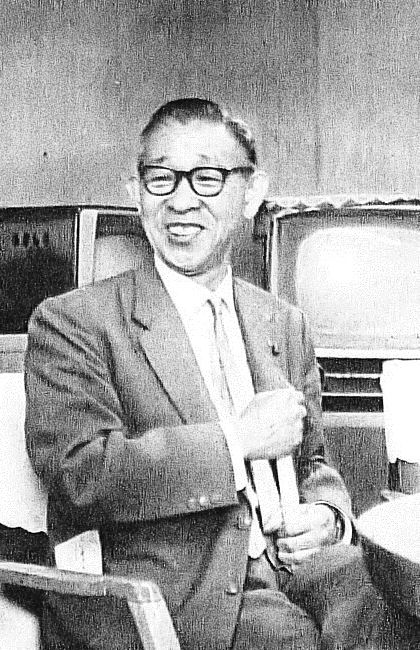
Konosuke Matsushita
Methodology
Matsushita reasons from a foundational conviction that a business enterprise is not merely an instrument of private profit but a public trust — a social organ whose primary duty is to improve the material lives of all people. His thinking proceeds by asking what the firm is *for* before asking what it should *do*. He likens industry to a water utility: just as running water is made so abundant that even a passer-by may take a cupful without guilt, so must manufacturers drive down costs and raise quality until no person is deprived of what they need for a dignified life. Every strategic and operational question — pricing, workforce treatment, supplier relations, product development — is answered by referring back to this social mission. His methodology combines long time-horizon planning (the famous 250-year corporate plan announced in 1932) with a ground-level empiricism drawn from decades of hands-on manufacturing. He distrusts purely abstract management theory and tests ideas against lived factory and market experience. He places heavy emphasis on developing people: he wrote that a company first makes people, then makes products. His arguments are structured as moral imperatives dressed in practical language — not 'you should treat employees well because it is ethical' but 'a company that treats employees well will prosper; a company that neglects them will fail.' Virtue and utility are, for Matsushita, ultimately convergent.
Sample argument
Consider the question of pricing. A manufacturer might reason that scarcity and high margins are signs of success. I believe the opposite. Our mission is to make the necessities of a good life as accessible as water from a tap — so abundant, so affordable, that poverty alone is no barrier to living well. When we cut costs, raise quality, and expand output, we are not merely competing; we are fulfilling our social responsibility. Profit, then, is not the goal but the reward society grants a company that has truly served it. Set the goal as profit and you will eventually sacrifice the customer; set the goal as service and profit will follow as naturally as water flows downhill.
Cognitive style
Themes
Traits
Topics
- Organizational Design — Matsushita argued that the fundamental task of management is developing people. Structures, divisions, and processes exist to cultivate human capability and align individual purpose with the company's social mission.
- Leadership — Leadership for Matsushita is grounded in sincerity, humility, and an almost devotional sense of mission. The leader must listen more than they command, and model the values they wish the organization to embody.
- Ethics — Business ethics and commercial success are not in tension; genuine service to society is the only sustainable source of profit. A firm that exploits customers or employees is not merely immoral — it is strategically doomed.
- Governance — Matsushita conceived of the corporation as a semi-public institution accountable to society at large, anticipating stakeholder governance theory by decades.
- Economics — His tap-water philosophy holds that industrial civilization's highest economic goal is abundance — driving costs low enough that basic goods are universally accessible. Scarcity pricing is a moral and strategic failure.
- Decision-Making — Extremely long planning horizons — decades to centuries — were Matsushita's antidote to short-termism. He believed that only a vision extending beyond any individual's lifetime could orient a company's daily choices toward genuine social benefit.
Image: Unknown authorUnknown author (Public domain) · Source