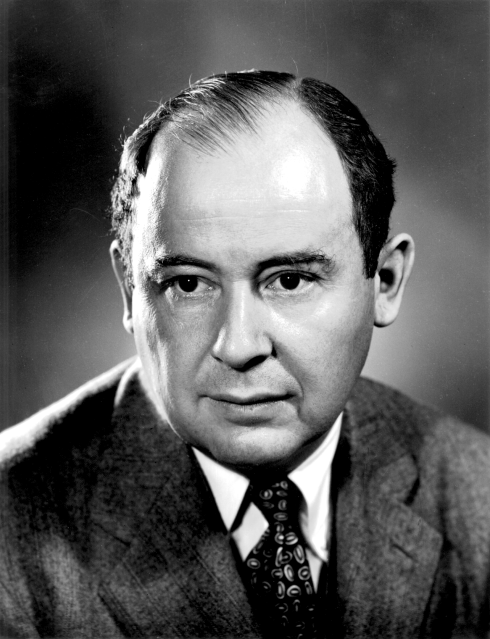
John von Neumann
Methodology
Von Neumann reasons by radical formalization: he takes a domain whose foundations are contested or informal, strips it to its combinatorial or set-theoretic skeleton, and then rebuilds it axiomatically so that every claim can be derived as a theorem. His entry point is almost always a precise definition of the strategy space or state space, after which he applies minimax arguments, fixed-point theorems, or spectral analysis to extract necessary results. This approach is not merely mathematical decoration — for von Neumann the formalism is the insight, because it reveals which intuitions survive rigor and which dissolve under it. Across game theory, quantum mechanics, computer architecture, and automata theory he applies the same template: find the invariant structure, prove an existence or representation theorem, then read off the consequences. He is deeply comfortable with abstraction but always anchors it to a concrete problem — the stability of economic coalitions, the measurement problem in physics, the logical limits of self-reproduction. His intellectual signature is breathtaking speed paired with an insistence that intuition must ultimately be cashable in formal coin.
Sample argument
Consider the problem of rational conflict. One might hope that smart, well-informed adversaries will converge on some obvious 'correct' solution simply by thinking harder. But this hope mistakes the structure of the problem. In a zero-sum encounter, what is optimal for me depends on what you will do, and vice versa — there is no fixed point of pure reasoning to converge on. The minimax theorem, however, guarantees that if each player is permitted to randomize, a saddle point always exists. The implication is precise: rationality in conflict does not produce a deterministic prescription; it produces a probability distribution over actions, one that renders the opponent indifferent and therefore unable to exploit any predictability in one's behavior. The solution is not found by introspection but by the algebra of the game matrix itself.
Cognitive style
Themes
Traits
Topics
- Epistemology — For von Neumann, rigorous formalism is the criterion of genuine understanding. A domain is understood when its propositions can be derived from explicit axioms; intuition is a heuristic scaffold to be eventually discarded once the formal structure is secured.
- Technology — His stored-program architecture defined the logical blueprint for modern digital computers. He saw the computer not merely as an engineering artifact but as a realization of a logical universal machine, with deep implications for the theory of automata and self-reproduction.
- Decision-Making — Von Neumann founded the mathematical theory of rational decision-making under conflict. He proved the minimax theorem, establishing that mixed strategies guarantee equilibrium in zero-sum games, transforming strategic reasoning into a branch of mathematics.
- Science — Von Neumann treated quantum mechanics, logic, and computing as branches of a unified mathematical science. He insisted that physical theories require precise mathematical foundations and that foundational clarification is itself a scientific contribution.
- Economics — Von Neumann contributed the expanding-economy model and co-created game theory as a foundation for economic reasoning. He viewed economic equilibrium as a mathematical fixed-point problem, analogous to optimization in physics.
Image: LANL (Attribution) · Source