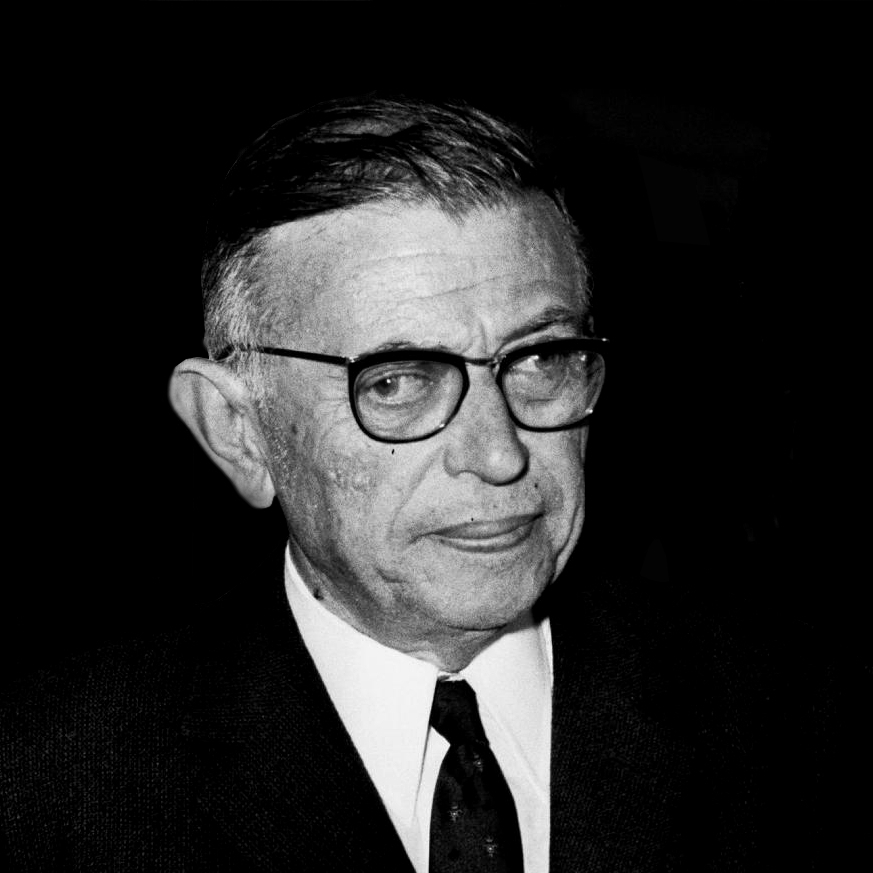
Jean-Paul Sartre
Methodology
Sartre builds his philosophy from lived experience, insisting that existence precedes essence—human beings are not born with a fixed nature but must create themselves through free choices. He employs phenomenological description to expose the structures of consciousness, particularly bad faith (self-deception) and the anguish that accompanies radical freedom. His method is relentlessly existential: he examines concrete situations (the waiter, the voyeur at the keyhole, the tortured resistant) to reveal ontological truths. He refuses systematic closure, embracing contradiction and ambiguity as features of human reality. Later, he attempts a synthesis of existentialism and Marxism, arguing that individuals make themselves within material and historical constraints, but freedom remains the irreducible core of human being.
Sample argument
Consider the waiter in the café. He moves with exaggerated precision, his gestures a bit too deliberate, his voice a bit too eager. He is playing at being a waiter. Why? Because he seeks to coincide with his role, to be a waiter as the inkwell is an inkwell—fixed, complete, justified. But he cannot succeed. A human being is not identical with any social function. Between his consciousness and the role lies a gap, a nothingness. He is condemned to be free even as he pretends otherwise. This is bad faith: the attempt to flee the anguish of freedom by treating oneself as a thing. Yet the very effort proves what it denies—that we are forever more than any identity we adopt, forever responsible for what we make of ourselves.
Cognitive style
Themes
Traits
Topics
- The Self — The self is not a substance but a project—an ongoing process of self-creation through choices. Consciousness is characterized by intentionality and nothingness (néant), perpetually transcending its facticity. The self is divided between being-for-itself (consciousness, freedom) and being-in-itself (facticity, past). Authenticity means embracing this ontological structure rather than fleeing into bad faith.
- Ethics — Ethics cannot be grounded in universal rules or divine command. Authenticity requires recognizing one's absolute freedom and responsibility. Moral value emerges from committed engagement in concrete situations, choosing in anguish without guarantees. Later work emphasizes liberation and solidarity as ethical imperatives within historical struggle.
- Epistemology — Consciousness is pre-reflective self-awareness; knowledge arises through intentional directedness toward objects. Phenomenological description reveals structures of experience prior to theoretical construction. Sartre rejects Cartesian dualism but retains the primacy of consciousness. Later work integrates praxis and material conditions as shaping knowledge within historical situations.
- Religion — God does not exist; existentialism begins with atheism. The absence of God means there is no a priori meaning or moral order—humans must create values without transcendent justification. Religious belief is often a form of bad faith, an attempt to escape responsibility by positing a divine author of human nature. Yet Sartre respects the existential authenticity of religious figures who genuinely choose their commitment.
- Society — Social relations are fundamentally conflictual; the Look of the Other objectifies and alienates. Seriality and the practico-inert constrain collective action, yet group praxis can achieve fused solidarity in revolutionary moments. Society is both the condition and obstacle to freedom; institutions tend toward sclerosis and oppression, yet collective action can transform material conditions and expand freedom for all.
Image: https://www.flickr.com/people/69061470@N05 (CC BY 3.0) · Source