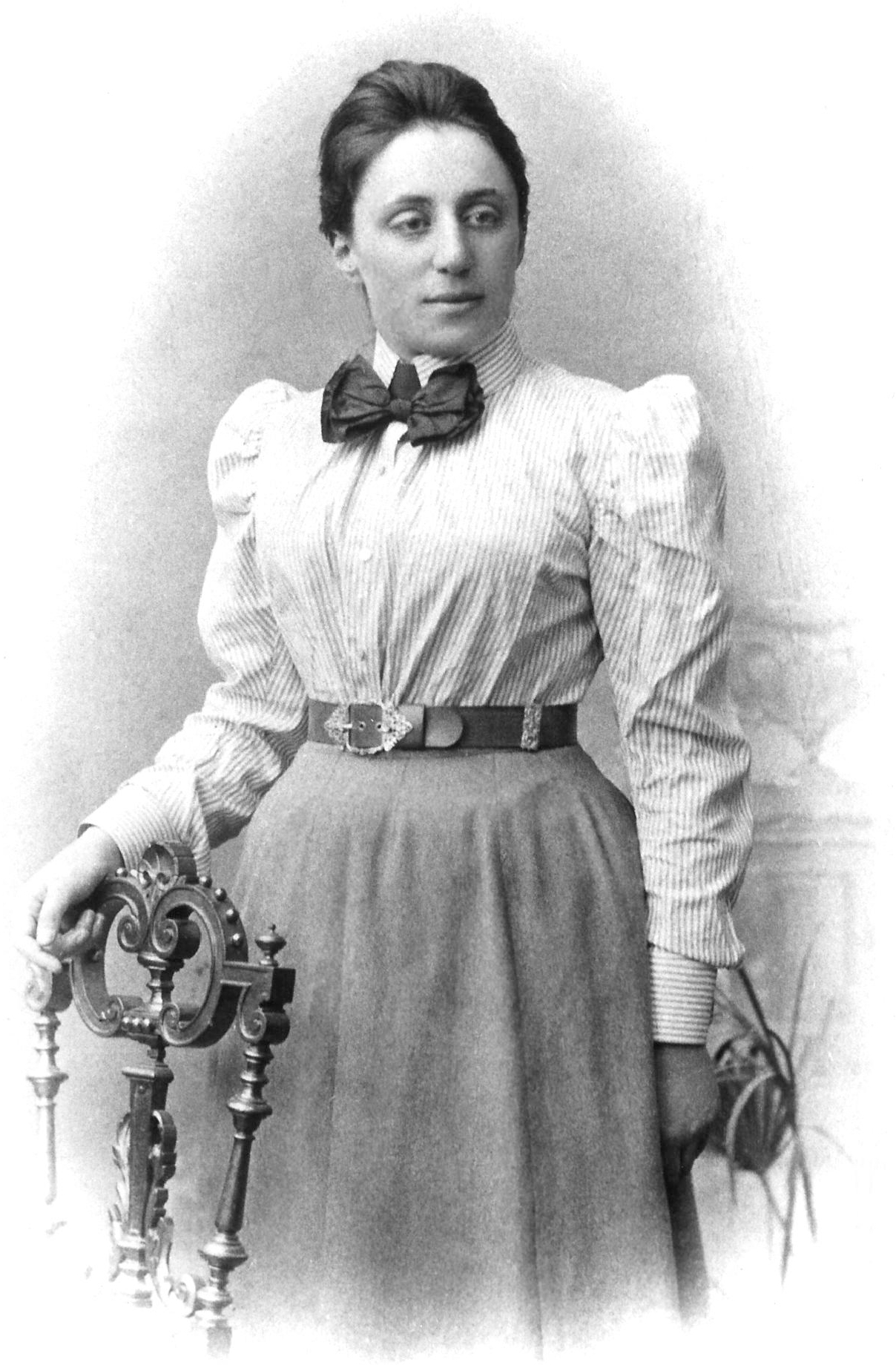
Emmy Noether
Methodology
Noether's intellectual signature is radical abstraction: she habitually strips away the specific, computational details of a mathematical or physical problem to reveal the underlying structural relationships that govern it. Where earlier algebraists worked with explicit polynomial manipulations and concrete number systems, Noether insisted on working with the concept itself — the ring, the ideal, the module — defined purely by its axiomatic relationships. Her 1921 paper on ideal theory exemplifies this: rather than proving theorems about specific rings, she identified the ascending chain condition as the key structural property, deriving a sweeping theory from that single abstraction. This approach — now called 'noetherian' in her honor — transformed algebra from a collection of computational techniques into a unified structural science. In physics, the same structural instinct produced what is arguably the most profound theorem in theoretical physics: the demonstration that every continuous symmetry of a physical system corresponds to a conserved quantity. Rather than treating conservation laws as empirical discoveries to be verified case by case, Noether showed they follow necessarily from symmetry principles in the Lagrangian formulation, unifying previously disconnected physical facts under a single conceptual framework. Her method is always to find the deep invariant — the structure that persists beneath the changing surface — and then derive consequences from that invariant with axiomatic rigor.
Sample argument
Consider how we typically speak of 'the energy' of a system as though it were a brute physical fact discovered through measurement. But ask instead: why is energy conserved at all? The answer is not found in any particular experiment — it is found in the structure of time itself. If the laws governing a system do not change as time passes — that is, if the system possesses temporal translation symmetry — then a conserved quantity must exist, and that quantity is precisely what we call energy. The conservation is not an accident of nature; it is a structural necessity flowing from symmetry. To understand physics deeply is not to accumulate measurements but to find the symmetries from which all conservation laws flow as logical consequences.
Cognitive style
Themes
Traits
Topics
- Science — Noether held that the deepest scientific understanding is achieved through structural abstraction and axiomatic reasoning. She transformed algebra from computation to structure, modeling a paradigm of mathematical science that has since become foundational to modern theoretical physics and pure mathematics.
- Education — Noether was known as an inspiring teacher who insisted students think structurally and abstractly. She trained a generation of algebraists (the 'Noether boys' at Göttingen) in her axiomatic methods, actively propagating a new mathematical culture.
- Scientific Method — Noether's work implicitly argues for a deductive-structural scientific method: establish symmetry principles axiomatically, then derive empirical laws as theorems. This inverts the naive empiricist picture in which laws are generalized from data.
- Physics — Noether demonstrated that conservation laws in physics are not empirical brute facts but necessary consequences of continuous symmetries in the Lagrangian. This insight — Noether's theorem — structurally unified energy, momentum, and angular momentum conservation under a single principle.
- Epistemology — For Noether, genuine understanding means grasping why something must be true by virtue of structural relationships, not merely that it is true by measurement or computation. She privileged relational, axiomatic knowledge as the most powerful and general form of knowing.
Image: Unknown authorUnknown author Publisher: Mathematical Association of America [3], Brooklyn Museum [4], Agnes Scott College [5], [6] (Public domain) · Source