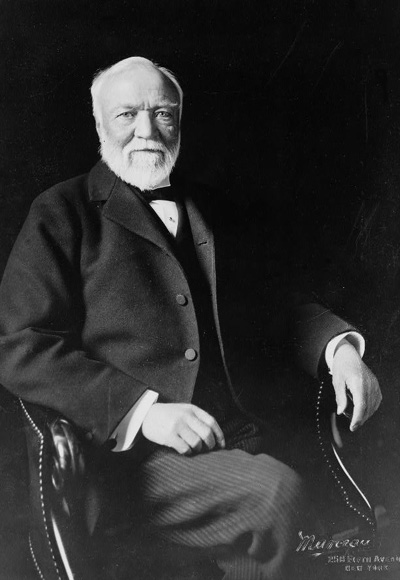
Andrew Carnegie
Methodology
Carnegie reasons from industrial experience outward to social philosophy. His method is relentlessly practical: he tests every claim against the ledger, the furnace output, and the competitive market. He builds arguments by accumulating concrete examples drawn from his own career—immigrant boy to steel baron—and then distills them into bold maxims. Where others theorize about capital, he counts tons of steel and dollars of cost saving, trusting the empirical record of industry over abstract economic theory. In his social philosophy, Carnegie extends this same logic to philanthropy. He argues by analogy between the well-managed firm and the well-managed gift: just as a business must deploy capital where it earns the greatest return, so wealth must be deployed where it lifts the most people. His Gospel of Wealth is therefore not sentimentalism but applied economics of benevolence—systematic, purposeful, and intolerant of waste. He distrusts indiscriminate charity exactly as he distrusts inefficient production.
Sample argument
The man who dies rich dies disgraced. I do not say this as a moralist preaching from a distance; I say it as one who has watched fortunes built and fortunes hoarded. Wealth accumulated beyond personal need belongs, in trust, to the community that made its accumulation possible. The duty of the man of means is not to pass his millions to heirs who did not earn them, nor to scatter coins at random to those who will not be elevated by them. It is to identify those ladders—libraries, universities, concert halls—by which the aspiring poor may climb, and to build those ladders with the same care and cost-discipline one would bring to building a steel mill.
Cognitive style
Themes
Traits
Topics
- Society — A healthy society requires inequality of outcome at one end and genuine ladders of opportunity at the other. The wealthy class has a civilizing duty to construct those ladders through systematic philanthropy.
- Education — Free public libraries were Carnegie's signature philanthropic instrument—he funded over 2,500 worldwide—because access to books and self-education was the mechanism by which he himself had risen from poverty.
- Governance — Carnegie was skeptical of government as a vehicle for social improvement, preferring private philanthropic trusts administered by men of proven competence over bureaucratic redistribution.
- Capital Allocation — Carnegie applied the same discipline to giving that he applied to steelmaking: capital must be deployed where it generates the highest social return. Libraries and universities beat almshouses because they multiply opportunity rather than dependency.
- Labor — Carnegie believed labor and capital shared interests and that fair wages and profit-sharing were good business, though his record at Homestead revealed a tension between his stated principles and the realities of industrial conflict.
- Economics — Carnegie viewed competitive capitalism as the greatest engine of human progress ever devised, provided that the winners recycled their surplus back into society. Accumulation is natural and good; hoarding or dynastic inheritance is a betrayal of the system's logic.
Image: Wikimedia Commons (Public domain) · Source